
Hypalon vs PVC | Stingray Marine
Comparison between Hypalon and Panatex
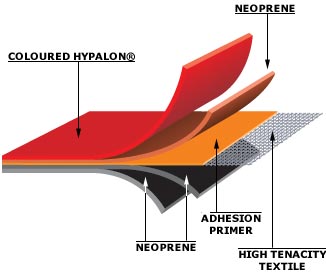
| Properties | Hypalon | PVC Coated Fabric |
|---|---|---|
| Mechanical Properties | ||
| Tear Resistance | Better than PVC | Not as good as Hypalon |
| Resistance to Abrasion | Better than PVC | Less than Hypalon |
| Low-Temperature Resistance | ||
| Low-Temperature Resistance | Excellent | Good when new but rapidly decreases with age |
| Porosity | ||
| Porosity | No porosity | Reliability less than 100% |
| Chemical Resistance | ||
| Gasoline and Diesel | Good | Does not resist |
| Cleaning Solvents | Good | Does not resist |
| Solvents | Fair | Does not resist |
| Greases and Oils | Good | Fair |
| Tar Derivatives | Good | Fair |
| Ageing | ||
| Heat and UV | Good | Progressive evaporation of plasticisers. With age, the material becomes stiff and brittle. |
| Weather | Good | Good but becomes sticky and dirty |
| Fading | Excellent | Good, becomes stiffer with age |
| General Properties | Excellent | Limited |
| Micro-organisms and Fungus | Excellent | Fair |
| Running Water | Good | Fair |
| Safety of Life at Sea (SOLAS) | ||
| SOLAS Approval | Approved | Not Approved |
Bonding Method
PVC:
There are two methods used to manufacture PVC pontoons:
1. Glue
The best glue for this purpose is two part PU heat reactivated glue. The life expectancy of the glue and PVC pontoon are approx 10 years. Please note that PVC pontoons are not suitable for extreme cold or extreme hot condition like the tropics. Due to the glue being heat reactivated, glue failure in the tropics and extreme heat may occur unless steps are taken to manage pressure/heat.
2. Thermo welding
This method is utilised and preferred by Stingray.
The PVC is thermo welded using a special thermal welding machine.
HYPALON:
Hypalon is a synthetic rubber and can only be glued. The glue is very specialised and unlike the glue used on PVC is not heat reactivated. The glue can withstand extreme cold and hot conditions. This is the choice of Military and Rescue organisations.